
Eurofighter Typhoon Guide
|
Updated: April 2013 When you read about the Eurofighter Typhoon you read about Tranches, Blocks, Phase Enhancements and Change Proposals but what does it all mean? To understand the Typhoon program you have to first look at a brief history of Typhoon. HistoryIn 1979 British Aerospace and Messerschmitt-Bolkow-Blohm produced a proposal to meet the needs of both the British RAF and West German Luftwaffe for a Cold War air supremacy fighter. Between 1979 and 1986 (when the first prototype took to the air) the partner nations tried to reach agreement over specification, requirements and how to approach the project. This saw the name of the project change from European Combat Fighter to European Combat Aircraft to Agile Combat Aircraft to Future European Fighter Aircraft and finally being called European Fighter Aircraft. The program would see the Italians along with the Spanish join and the French join then leave, twice! The 1990s saw arguments, politics and negotiation around the radar supplier and how the work should be shared between the four countries. With the Berlin Wall coming down, the end of the Cold War and the scaling back of defence budgets the partner nations reduced the number of aircraft they would commit to. The Germans would make the biggest cut, reducing from 250 down to 140 before raising it up to 180 after lengthy negotiation to limit the associated impact to their share of the industrial contracts to build the aircraft. Further delays to the project would occur in the late 90s with the Germans still struggling with the cost of the reunification. They would delay making their payment for the construction phase, putting back the project by a year. Type acceptance for Typhoon finally came on 30th June 2003 four year after originally planned and the first delivery was made to the German Luftwaffe on 4th August 2003. In 2003, Austria became the first export customer for Eurofighter with an order for 15 Typhoons. Delivery began in July 2007 and the first operational air policing missions began in June 2008. Their final Typhoon was delivered in September 2009. Saudi Arabia became the second export customer in September 2008 with an order for 72 Typhoons. 24 of these will be diverted from the RAF’s Tranche 2 production and by the end of 2012 all of these had been delivered and accepted. Originally it was planned for the other 48 to be locally assembled in Saudi Arabia but price negotiations are now on-going for the 48 to be built by BAE at their Warton plant. Production in 2010 reached 50 Typhoons a year and the 250th was delivered to the Italian Air Force in December 2010. After several years the Sultan of Oman finally signed an order for 12 Tranche 3A Typhoons for delivery in 2017. This made Oman the 3rd export customer and the 2nd Middle Eastern customer. It also brings the total number of Typhoons ordered to 571. TranchesWith a number of different nations involved in a project as large as this, all with an equal say, there was always going to be disagreement, delays and a lot of politics. In an attempt to make reaching agreement easier Typhoon would be produced in three tranches. Each tranche is a separate contract between the partner nations and Eurofighter GmbH for an agreed number of aircraft. This would allow the partner nations the flexibility to change the number of aircraft they order over the construction period but at the cost of having to pay compensation to Eurofighter GmbH to assure construction and development continues without an increase to the unit price for the other partner nations. Whilst the three tranches are financial divisions it also allows specification changes to the aircraft from the framework laid out at the start. This allows new features to be added or deleted as required even at an individual nation level.
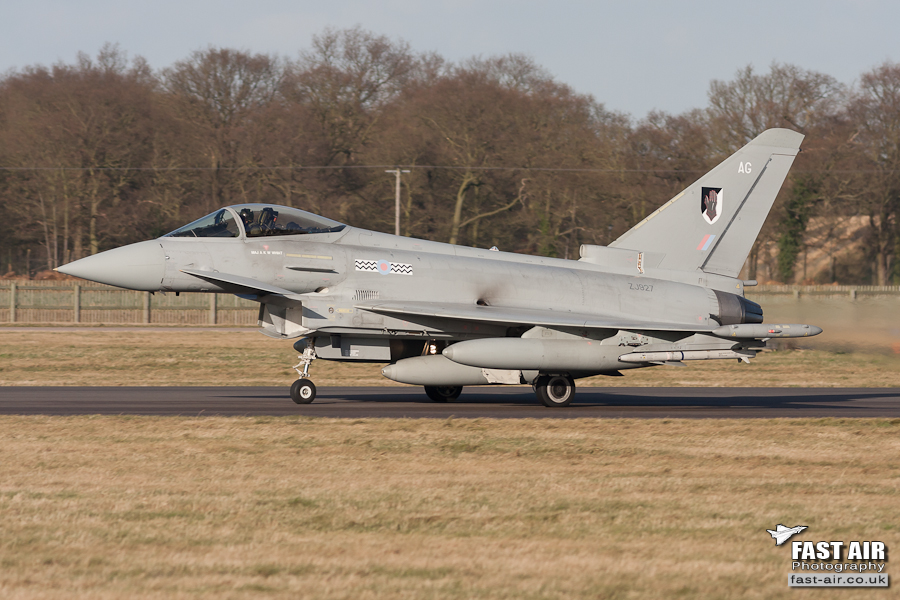
Eurofighter Typhoon Tranche 1 Block 1BlocksWhere the tranche is a financial division, the block is a capability baseline. With each block a new collection of capabilities are introduced which will be built upon. The block approach is a common method used for military aircraft to roll out hardware upgrades, software upgrades, new hardware and / or structure change. Tranche 1 consists of Block 1, 1B, 1C, 2, 2B, 5 and 5A (which was the 6 Typhoons for Austria). Tranche 2 consists of Block 8 (8 of which diverted to Saudi Arabia), 8A, 8B (6 of which diverted to Saudi Arabia), 9 (10 of which diverted to Saudi Arabia), 10, 10C (which was the first dedicated block for Saudi Arabia), 11, 11C (for Saudi Arabia), 15 and 15C (for Saudi Arabia). Tranche 3A consists of Block 20, 25 and 25C (the final 24 for Saudi Arabia). Each block was to build on the previous one. The RAF has committed to have a standardised Tranche 1 fleet and their Block 1 and 2 Typhoons underwent the Retrofit 2 (R2) upgrade to bring them up to the Block 5 standard. The process took 7 months for Block 2 aircraft and 12 months for Block 1 aircraft and was completed in November 2012. A total of 43 Typhoons were upgraded over six years and the final Typhoon to be upgraded was ZJ932 which returned to XI(F) Squadron. There will be no upgrades from Tranche 1 to Tranche 2 due to the physical differences between the two builds. A list of UK Typhoons split into their Blocks with construction number and serial can be found here -> UK Typhoons by Block Enhanced Operational Capability
The development plan was at Block 5 (the final block in Tranche 1) Typhoon would be at Full Operational Capability (FOC). By Block 10 (the penultimate block in Tranche 2) it would be Enhanced Operational Capability 1 (EOC-1) and Block 15 (the final block in Tranche 2) it would be EOC-2. The development plan for Block 20 / Block 25 in Tranche 3 was to be left open. These plans were drawn up in the Cold War when the West was focused on the USSR. Times, budgets and requirements all changed after the Berlin Wall came down and the plan had to change. Changes to the plan would be presented as Change Proposals and voted on by the partner nations. Any of the nations could veto a change.
Eurofighter Typhoon Trance 1 Block 2 Upgrade to Block 5Change Proposal 193 (CP-193)In 2006 the RAF had Tornado GR4s deployed to Iraq and Harriers deployed to Afghanistan both providing close air support to troops on the ground. The RAF needed Typhoon to have an air-to-ground capability. In July 2006, under CP-193, an “austere” air-to-ground capability was rapidly developed and deployed to Trance 1 Block 5 Typhoons. The austere capability provided integration of Litening III Laser Designator Pod and laser guide munitions in the form of Paveway II / Enhanced Paveway II. The RAF changed the designation of these Typhoons from F2 to FGR4 to denote the ground attack and recon role as well as the fighter role. The first Paveway II was dropped on 12th November 2007 by a combined BAE and RAF test team and the Typhoon was declared multi role capable on 7th July 2008. On the 12th May 2011 the RAF’s Typhoons put the austere air-to-ground capability to use as part of OP ELLAMY, the UK’s contribution to enforcing the UN Security Council Resolution 1973 over Libya, when a Typhoon destroyed two main battle tanks near Misrata using Paveway II. This created a strange situation where Tranche 1 Block 5 aircraft had both air-to-air and limited air-to-ground capability whilst newer Tranche 2 Block 8 aircraft with over 400 improvements over Tranche 1 aircraft had only an air-to-air capability. The crux of the problem is software. The modification to the Typhoons software made by CP-193 was outside the development path. If they continued with two development paths (one with CP-193 for the RAF and one without for the other nations) you would need to develop and flight test both versions of the software with the RAF would have to pick up the bill for the duplication of work. By getting all nations to agree to include air-to-ground capability (CP-210) the RAF and Eurofighter GmbH had managed to bring this software modification into the main development path of the software but not soon enough to have it include in the new Block 8 builds but being a software change it would be included later. Change Proposal 210 (CP-210)In 2007, the partner nations approved a change of requirement under Change Proposal 210. CP-210 would give Typhoon an air-to-ground capability. This would change Typhoon from an air supremacy fighter to a swing-role fighter capable of performing both the air-to-air role and air-to-ground role. CP-210 would be delivered via Phase 1 Enhancments.
Eurofighter Typhoon Trance 1 Block 5 with LITENING III podPhase 1 Enhancements (P1E) Phase 2 Enhancements (P2E)With the change to a swing-role fighter the development plan defined in EOC-1 and EOC-2 no longer matched where the development of the aircraft was heading. To this end, both were replaced with Phase 1 Enhancement (P1E) and Phase 2 Enhancement (P2E) respectively. For a while it did look like P2E was going to be abandoned in favour of another method but P2E is now back on the development path along with plans for P3E and P4E in the future. The cost of P1E is £458 million and is fully funded by the partner nations and will develop the Tranche 2 aircraft. Phase 1 Enhancement was split into two parts, A and B. Phase 1 Enhancement A – P1EAP1EA is an important milestone for Typhoon and provides the following capabilities and improvements:
The flight testing was completed in May 2012 with each partner nation being assigned a part of the P1EA program to develop. The data and results from each of these are collated by Eurofighter GmbH who will then pass it to the NATO Eurofighter and Tornado Management Agency (NETMA) for approval. It is expected NETMA will give its approval to the combined program at the end of 2012 allowing a national assessment by each nation (since each nation only carried out parts of the program there will be parts they will not be familiar with). The national assessment for the UK is carried out by QinetiQ in partnership with the OCU and OEU (29(R) Sqn and 17(R) respectively) and should take three months to complete before P1E gets its release to service. A series of overruns and the integration of lessons learnt from Op ELLAMY resulted in the original date for P1EA slipping from the fourth quarter of 2011. Phase 1 Enhancement B – P1EBP1EB is scheduled to deliver the following enhancements and new capabilities:
Flight testing for P1EB has begun and is expected to take a year to complete. Phase 1 Enhancement X (P1EX)Beyond P1EB there is a suggested P1EX for the next lot of enhancements but at this stage there isn’t any funding in place for it or a firm list of enhancements to be delivered. The release schedule for the Service Release Packages suggests it won’t be happening. Phase 2 EnhancementExpected to be delivered in three parts, P2EA, P2EB and P2EC. Software Releases – SRPsA Service Release Package is a complete package of hardware, software and clearances. SRP 4.1 is Tranche 1 Typhoons available to all partner nations. Delivers only air-to-air capability. SRP 4.2 is a UK only release for Tranche 1 Typhoons that includes the “austere” air-to-ground capability agreed in CP-193. SRP 4.3 is the latest release for Tranche 1 Typhoons available to all partner nations and includes the “austere” air-to-ground capability agreed in CP-210. SRP 5.0 is the first release for Tranche 2 Typhoons. Delivers only air-to-air capability. Developed from SRP 4.0 and wasn’t well received especially by the Saudis. SRP 5.1 is the latest release for Tranche 2 Typhoons developed from SRP 4.3. Addresses problems found in SRP 5.0. Includes improvements to DASS, MIDS and radar performance. Aircraft on this SRP will have the same air-to-air capability as Tranche 1 SRP 4.3 aircraft but can only drop unguided bombs or Paveway II LGBs if another aircraft provides the laser targeting due to SRP 5.1 not having any integration with the Litening II LDP. SRP 10 will be the release of the Phase 1 Enhancement A – P1EA. SRP 12 will be the release of the Phase 1 Enhancements B – P1EB. SRP 14 will be the release of the Phase 2 Enhancements – P2E and is expected to further increase the available weapons with Storm Shadow, Brimstone and initial Meteor capability. SRP 16 is expected to be the release of Phase 3 Enhancements – P3E and deliver full Meteor capability. SRP 18 is expected to be the release of Phase 4 Enhancements – P4E and AESA radar. SRPs are further divided into Production System Configurations (PSC) which will denote smaller changes to the configuration like a different hardware component or a Drop package. Drops / Restore / Strongbow Just when you think you’ve read about all the different programs and upgrade paths for Typhoon another one appears. The Phase 1 Enhancement programs will continue to develop Tranche 2 Typhoons but after the Main Development Contract (MDC) ended so did development of the Tranche 1 Typhoons. Drops are a means by which the UK is adding additional functionalities and capabilities to Tranche 1 aircraft via software updates. Since development is no longer on going for Tranche 1 there isn’t any problems with branches being created from the main software program but the UK is limited to only developing the parts of the Tranche 1 program they were responsible for. The program is run by the Capability Sustainment Team of BAE Systems and Drop 1 was introduced in 2011. The capabilities were used on the RAF’s Tranche 1 Typhoons that took part in Op ELLAMY. Drop 2 was developed in partnership with the German National Support Centre (SUZ). The first flight was conducted from RAF Coningsby in May 2012 and then assessed by 17(R) Squadron as part of 2012 High Rider. The first upgraded Typhoons took part in Red Flag in early 2013. The rest of the RAF Tranche 1 Typhoons will be upgraded in 2013. The German Air Force also intends to adopt it in 2013. Drop 3 will see all partner nations adopting the program under Tranche 1 Evolution Package 1 (T1EP1). With each partner nation joining more elements of the Typhoon can be developed so having all four on board is an important step. The Drop program is also feeding back into the development of the Tranche 2 Typhoons with Drop 1 and Drop 2 being adopted into P1EA. Strongbow is a UK project that is part of a larger program called Restore. No details are in the public domain on what these projects include but it is assumed that they are related to the Drop programs and the development of Tranche 1 Typhoons. Presently it appears as if this program has been cancelled or at least put on hold.
Eurofighter Typhoon Trance 2 Block 8ContractsContract 1 is a five year agreement, signed in May 2012, which brings together a number of maintenance contracts. The contract sets out agreed timescales for repair services (an issue highlighted in the NAO’s defence spending report). There are also Contract 2, 3 and 4 but only 4 have been signed at this time. Contract 4 covers future developments and should make it easier for individual partner nations to pursue upgrades without the agreement of all the partner nations. Tranche 3With pressure increasing on defence budgets, especially for the British MoD who had a £36 billion pound funding black hole, Tranche 3 was under a very real threat of being cancelled. The partner nations, in particular Germany, applied pressure on the British Government to sign the contract but the British insisted that costs must be reduced before they would do that. To help the situation the tranche was broken into two parts, Tranche 3A and 3B. A breakthrough was finally made with the British agreeing to take their full allocation of 40 Tranche 3A Typhoons in exchange for £900 million worth of savings achieved from reductions to the support contracts by BAE, Rolls-Royce and other partners. Tranche 3A is due to start being delivered in 2013 and complete in 2016. 112 Typhoons are currently on the order book with the UK having 40, Germany having 31, Italy having 21 and Spain having 20. The exact specification of Tranche 3A isn’t known at the time of writing as it is still being negotiated (the Tranche 3A contract signed only agrees to the production of a Tranche 3A not the capability of those aircraft) but it is expected they will be based on Tranche 2 with Phase 1 Enhancement along with provisions for E-SCAN, conformal tanks and a dump fuel system. In September 2012, Alenia Aermacchi shipped the first set of wings and rear fuselage to BAE System’s Warton plant for the first Typhoon 3A which will be construction number BS116, a single seat FGR4 for the RAF. The British MoD has stated that with the signing of the contract for the production of Trance 3A the program had reached the financial ceiling as agreed in the Memorandum of Understanding (MoU) and therefore had no further obligation to purchase their allocation of Tranche 3B Typhoons. Eurofighter GmbH at the time said this would be a matter for the partner nations to discuss and in May 2010 submitted a proposal to the partner nations for the 124 Tranche 3B Typhoons. Eurofighter GmbH hopes to have a decision by 2012 allowing them to keep production going. If the partner nations do not take their allocation the future of Trance 3B looks bleak. The British haven’t totally ruled out making further purchases of Typhoons, instead saying they are unlikely to do so but reserve the right. The Italian Defence Minister said in July 2010 that they would be cutting their order by 25 aircraft, representing the Italians allocation of Tranche 3B aircraft. BAE Systems have said they have forecast the Tranche 3B not being signed on time in their financial projection released in 2011. Without Tranche 3B to keep the production lines open Eurofighter GmbH must attract more export customers or sell more Typhoons to the current export customers. There is little chance of Austria purchasing more Typhoons but Saudi Arabia does have an option for a further 24 Typhoons. The purchase of 84 F-15S fighters has put this in doubt making new export customers the best option. In May 2010 a proposal was put forward to reduce the delivery rate of the Typhoon to the partner nations to give the Eurofighter consortium the capacity needed to be able to produce Typhoons for export customers rather than divert Typhoons from partner nations as has happened so far. The proposal was agreed in July 2011 by all four partner nations and deliveries will be reduced to 43 from 53 for 2012 and a similar number for 2013. This reduction in delivery rate will also extend production for two more years allowing more time for export customers to be found. The French have already adopted this strategy for the Rafale and reduced production to just 11 aircraft a year whilst it attempts to find its first export customer. With both the Rafale and Typhoon looking for export customers it’s not a surprise that they end up competing against each other and both aircraft have made it down to the final shortlist for the India Air Force’s MMRCA competition. The winner will get a $10.5 billion contract to provide 126 aircraft to the Indian Air Force. As well as providing work for the production lines this contract would also help fund the continuing development of the fighters, which would in turn help win further contracts. Dassault’s Rafale was given preferred bidder status after winning the MMRCA competition on 31st January 2012. This doesn’t mean Dassault has got the contract yet rather it now makes it Dassault’s deal to lose and they will be trying very hard to make sure that doesn’t happen. Dassault was awarded the status after submitting a lower cost in the sealed bid process. The actual figures aren’t publically available but without an export customer and a large portion of the French Air Force’s budget committed to keeping the Rafale production line open I suspect they were prepared to cut their profit margin more than Eurofighter. The Rafale had also scored well in the technical evaluation for the MMRCA competition and its EW capability, sensor fusion and ability to attack more than one ground target in an attack run in particular. Typhoon will need to reach SRP 12 before it can attack multiple ground targets. SRP 10 was due in 2011 and SRP 12 in 2012 but to my knowledge no production aircraft have yet received SRP 10. Eurofighter also missed out on the $6 billion order to provide 40 to 50 fighters to the Japan Air Self-Defense Force. After spending a number of years trying to get the US to export the F-22 Raptor without success the Japanese considered the Super Hornet, Typhoon or F-35 as replacement to their aging F-4EJ and RF-4EJ fighters. They opted to go for the F-35. With the Chinese developing a ‘fifth generation’ fighter the Japanese felt they needed to purchase the most advanced aircraft available but with the first four not being delivered until 2016 they are waiting a long time for them (assuming no more delays to the troubled F-35 program). There also a number of smaller competitions (all the export contracts they are involved in are listed below). These include a surprise request for information from UAE. Dassault was thought to have secured the contract with the UAE for 60 Rafales to replace their Mirage 2000-9 aircraft after years of negotiation. The UAE was expected to sign the contract at the 2011 Dubai Airshow but instead requested information from the UK government about the Typhoon and made a similar request to the US government about the Super Horner and F-15E. Export Contracts – WonSaudi Arabia
Oman
Austria
Export Contracts – Competing ForIndia
United Arab Emirates (UAE)
Canada
South Korea
Qatar
Denmark
Kuwait
Malaysia
Bahrain
Jordan
Future UpgradesAn important part of attracting export customers is to adopt cutting edge technology into Typhoon. Whilst Typhoon fairs well against current competitors it will soon be fighting against the F-35 for export customers and further upgrades will be required to keep it competitive. Future upgrades are also important to the RAF. With the current out of service date for Tornado being 2019 they will need Typhoon to have full integration on both Brimstone and Storm Shadow before this date to avoid a capability gap. Improvements to the recce capability will also be needed to replace the RAPTOR pod of the Tornado GR4. The current possible developments to the Typhoon are the AESA radar, TVR engines and CFTs. AESA (Advanced Electronically Scanned Array) RadarThe CAPTOR-M radar in Typhoon is a mechanical radar that physically moves to scan (M-SCAN). Electronically scanning (E-SCAN) radars are rapidly improving and appear to be the future of radar design. Tranche 3A aircraft have the structure, power and cooling requirements to support its addition. Tranche 2 aircraft only have the structural requirements meaning that a retrofit program would be needed to support its addition. Eurofighter Development Aircraft 5 (DA5) has already flown with an AESA radar in May 2007; using the AESA front end and the CAPTOR-M back end and referred to as CAESAR. Full scale development of the AESA radar has begun and the in service date is 2015 for both partner nations and export customers. The radar being produced by Euroradar is a multi-national consortium led by SELEX Galileo. SELEX Galileo are currently developing the AESA radar for the Saab Gripen NG. Separate to this development program the UK have funded a technology demonstrator program under the name Bright Adder. It will also be in partnership with SELEX Galileo and will concentrate on the UK’s requirements for an AESA radar system such as the electronic attack feature that is currently provided by the Alarm missile on the Tornado GR4. When both the GR4 and the Alarm have been withdrawn from service the UK needs the Typhoon to have the capabilities to carry out the missions that both of these currently perform. SELEX has made a press release that says the demonstrator will fly in 2013 and confirmed the service entry date as 2015. Conformal Fuel Tanks (CFT)Like other fighter aircraft Typhoon is capable of using external (drop) tanks to increase its fuel capacity. These tanks can be fitted to the three wet points located on the fuselage centre point and the middle point on both wings. The addition of these tanks do bring a number of drawbacks. The loss of the two wing points means less points to attach ordinance and the centre point is also used to attach a targeting pod. The tanks also increase drag; although Typhoon is still capable of going supersonic with all three tanks fitted (tested to Mach 1.6 with three 1000 litre tanks). Conformal Fuel Tanks would offer a solution to this problem with two semi-permanent tanks grafted onto the fuselage, each offering 1500 litres of fuel, without the loss of any points and reduced levels of drag. You will have seen them used on the F-15E Strike Eagle and starting to be seen more commonly on F-16s. At present only Britain has shown interest in having CFTs. BAE have tested a scale model in a wind tunnel and are working on development with GKN Engage. The provision for CFTs will be made for Tranche 3A Typhoons onward.
Eurofighter Typhoon Trance 1 Block 2B with three 1000 litre drop tanks3D Thrust Vectoring Control (TVC)Thrust Vectoring Control allows the nozzle on the engine to be deflected to enhance the agility of the fighter. With 3D TVC the nozzles are able to move up, down, left and right or a combination e.g. up and left. No partner nation has expressed an interested in having TVC. Eurojet, the consortium of companies that produces the engines for Typhoon, is hoping to attract support for TVC by concentrating on the benefits provided above the enhanced agility. Eurojet has said TVC would decrease fuel burn, increase the life of hot running components and reduce take off distance (particularly useful in ‘hot and high’ environments).
Eurofighter Typhoon Trance 1 Block 5Other Planned ChangesAbove are the major upgrades that are being considered for the near future. Other upgrades are also being considered and explored but on a lower priority. Leading Edge Root Extension (LERX) LERX is a common modification to fighter aircraft. It is a triangular shape that fits to where the wing and the body of the aircraft meet (anyone who is familiar with the Harrier GR7 to GR9 upgrade will have seen it) and is designed to control the airflow over the wing. By generating a vortex on the top of the wing air can be flowed under the wing causing an increase in lift. In high angle of attack manoeuvres this allows keeps the air flowing over the wing past the normal point an aerodynamic stall would occur. This offers an advantage in dog fights. The developed Typhoon DA5 flew with LERX fitted between Sept and Oct 2007 but no further developed has occurred since. Laser Designator Pod (LDP) Position The LDP is currently fitted to the centre position on the Typhoon but on the Eurofighter 2020 illustration the LDP is shown fitted on the front left of the fuselage (in a similar position to where the F-16 has its LDP). The current position of the LDP may be due to the “austere” nature of the air to ground capability introduced by CP193. When the full air to ground capability is introduced we might see the LDP move freeing up the centre position for either a drop tank or a weapon. Passive Missile Warning The Eurofighter 2020 illustration also has Passive Missile Warning with a pointer to the rear of the Typhoon. The PIRATE has a Passive Missile Warning capability but of course this is forward looking so it would appear they are considering a rear looking Passive Missile Warning capability for the Typhoon. |



Share This


About the author

7 Comments for Eurofighter Typhoon Guide

Just linked to this excellent reference from Think Defence
Thanks for maintaining it
http://www.thinkdefence.co.uk/2013/02/typhoon-blocks-tranches-and-enhancement-programmes/

Thanks for linking to it again.
I intend to do periodic updates to it as the the Typhoon programme develops.
If anyone reading this has any developments or corrections please give me an e-mail – photos@fast-air.co.uk
Gordon.

TD,
I might have missed it in all the detail, but are there any plans for Typhoon to carry an anti-ship missile such as the Harpoon or Joint Strike Missile? (This would make the aircraft more attractive in the Asia-Pacific region when competing against the F/A-18E/F Super Hornet or F-15E Strike Eagle, which can both carry the Harpoon.)
Both the Harpoon and the Penguin anti-ship missiles are planned to be integrated with the Typhoon but they are further down the development plan. Of course, if they got an export customer who wanted that facility I’m sure it would be brought forward.
[…] For a comprehensive rundown of the various flavours, click here […]
[…] Typhoon Guide : the step-by-step developments detailed ; #proposal | RT @thinkdefence : fast-air.co.uk/typhoon-block-… – […]
Social Media


[…] […]